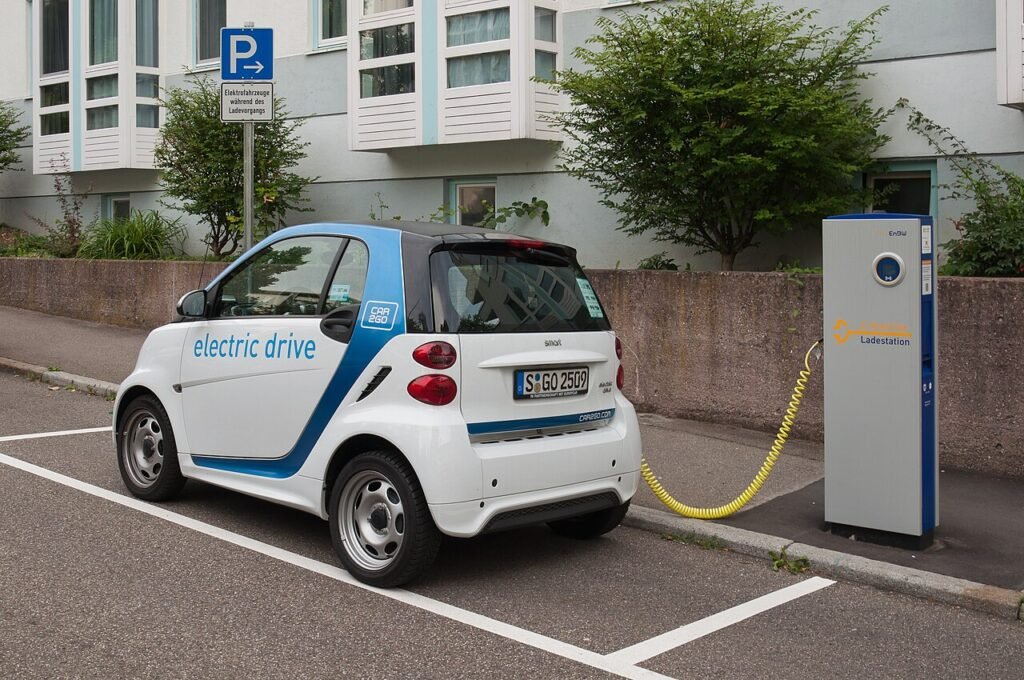
Why fleet composition matters more than it used to
Saudi Arabia’s private hire market has changed shape over the past few years. Riyadh and Jeddah now have visible electric vehicle charging infrastructure, several international hotel groups ask about low-emission arrivals for corporate guests, and a growing number of business travellers simply prefer a quieter, smoother ride between meetings. At Saudi Cab Co we get asked, more often each quarter, whether an electric or hybrid vehicle is available for a booking. This guide sets out honestly what is realistic today, what the trade-offs are, and how to request one.
What “electric chauffeur” actually means on the ground in Saudi Arabia
Electric vehicle uptake in the Kingdom is real but still concentrated in specific corridors: central Riyadh, parts of Jeddah, and increasingly NEOM and other giga-project sites where charging infrastructure has been built in from the start. Long intercity runs, such as Riyadh to Dammam or Jeddah to Taif, are still better served by a hybrid or a well-maintained petrol vehicle, simply because rapid-charging coverage on the open highway is not yet consistent enough to guarantee a reliable schedule for a client with a flight to catch.
Hybrid vehicles sit in a more practical middle ground right now. They do not depend on charging infrastructure, they cut fuel consumption noticeably in stop-start city traffic, and they are mechanically familiar to every workshop in the country, which matters for maintenance turnaround. For many corporate accounts, a hybrid sedan is the more dependable “green” choice for 2026 bookings.
Where electric vehicles work well
- Point-to-point transfers within Riyadh, Jeddah or NEOM where charging is nearby.
- Half-day or full-day hire where the vehicle can charge between assignments.
- Hotel and venue arrivals for clients who have specifically requested a low-emission vehicle for sustainability reporting.
Where a hybrid or conventional vehicle is the safer choice
- Long intercity transfers, particularly across the interior or through areas with sparser infrastructure.
- Time-critical airport collections where any uncertainty about range is not worth the risk.
- Multi-stop itineraries with unpredictable waiting time built in.
How to request an electric or hybrid vehicle
When you book, use the vehicle notes field to specify “electric preferred” or “hybrid preferred”. Our dispatch team will confirm availability against the route before your journey is finalised, because we would rather tell you upfront that an electric vehicle is not practical for a particular route than leave you stranded with a low battery on a desert highway. For guaranteed availability on a specific date, we recommend booking at least 48 hours ahead, since our electric and hybrid fleet is a smaller subset of the total fleet and demand from corporate accounts has been rising.
Chauffeur training for electric vehicles
Drivers assigned to electric vehicles complete additional briefing on regenerative braking behaviour, which changes how a vehicle decelerates compared with a conventional automatic, and on charging logistics so that a booking is never put at risk by a driver having to divert for power mid-journey. This is a small operational detail but it is the difference between a smooth transfer and an awkward one.
What this means for pricing
Electric and hybrid vehicles are not automatically more expensive to book, though premium electric models in the luxury tier are priced the same as their equivalent conventional luxury sedans. Where an electric vehicle is requested for a long-distance route that genuinely requires a charging stop, we will flag the additional time this adds so the fare and schedule both reflect reality rather than an optimistic assumption.
Looking ahead
As NEOM, Riyadh’s metro-linked business districts and the Red Sea developments continue to build out charging infrastructure, we expect the practical range of routes suited to electric vehicles to expand steadily. We review our fleet mix against this infrastructure roll-out regularly rather than committing to an all-electric fleet ahead of the charging network being ready to support it reliably.
Sustainability reporting and corporate travel policy
A growing number of the multinational firms we work with in Riyadh and Jeddah now track ground transport emissions as part of their own sustainability reporting, particularly firms with net-zero commitments that extend to business travel. If your organisation needs to report on this, our dispatch team can confirm which of your bookings used an electric or hybrid vehicle, which is a simple but genuinely useful data point for a travel manager compiling a quarterly or annual report. We are also happy to work with corporate accounts to set a standing preference for electric or hybrid vehicles wherever a route allows it, rather than requesting this on a booking-by-booking basis.
Noise, ride quality and passenger comfort
Beyond the environmental angle, there is a genuine comfort case for choosing an electric vehicle where the route supports it. Electric motors are near-silent at low speed, which makes a real difference in heavy city traffic where a conventional engine is constantly working through stop-start conditions. Several of the executives we drive around Riyadh and Jeddah specifically request an electric vehicle for this reason alone, independent of any sustainability consideration, because the cabin is quieter for calls and the ride is notably smoother without gear changes.
Maintenance, range confidence and why we do not overpromise
Every electric and hybrid vehicle in our fleet is serviced on a schedule specific to its drivetrain, since battery health, regenerative braking components and hybrid transmission systems need different attention to a conventional combustion vehicle. We track real-world range for each electric vehicle against the routes it is assigned to, and we deliberately keep a safety margin between a vehicle’s rated range and the maximum distance we will assign it without a planned charging stop. This is a conservative approach by design: we would rather under-promise on which routes suit an electric vehicle today than have a client experience range anxiety or, worse, an actual delay because a booking was pushed past what the vehicle could comfortably manage.
Frequently asked questions
Can I request an electric vehicle for an airport pickup?
Yes, provided the route between the airport and your destination falls within a corridor our dispatch team has confirmed as suitable. Central Riyadh and Jeddah routes are usually straightforward; longer transfers out to the edge of the metropolitan area may be better served by a hybrid.
Do electric vehicles cost more to book?
No, not as a rule. Standard and premium electric vehicles are priced the same as their conventional equivalents in the same class. Only where a route genuinely requires a charging stop, adding real time to the journey, will this be reflected in the schedule and, where relevant, the fare.
What happens if the electric vehicle I requested is not available on the day?
Our dispatch team will contact you ahead of the booking to confirm a suitable alternative, typically a hybrid, rather than substituting silently and leaving you to discover the change at pickup.
Are electric vehicles available in the luxury and executive tiers, or only standard class?
We carry electric options across both standard and premium tiers, including executive-class electric sedans for corporate clients who specifically want a low-emission vehicle without stepping down in cabin quality or presentation.
How do I know if my specific route is a good fit for an electric vehicle?
Tell us your full route, including any planned stops, and our dispatch team will check it against current charging infrastructure and confirm suitability before your booking is finalised, rather than leaving you to guess.
Related guides
- Choosing an SUV for desert and mountain routes in Saudi Arabia
- Luxury and VIP fleet options: when to upgrade your Saudi transfer
- Vehicle safety checks: what to look for before you book a Saudi transfer