Private transport across Saudi Arabia
support@saudicabco.comTravel and partnership desk

A Domestic Traveller’s Guide to the Esports World Cup in Riyadh

Reviewed travel guidance. This article is general planning guidance for domestic travellers attending events in Riyadh. Always check the official event schedule and venue information before you travel, since timings and locations can change between editions.

The Esports World Cup has grown into one of the biggest recurring events on Riyadh’s calendar, drawing competitors, teams and fans from across the Kingdom for weeks of gaming, tournaments and side events spread across several venues. For a domestic traveller coming from Jeddah, Dammam, or another Saudi city rather than flying in internationally, the planning question is slightly different: less about visas and more about making sense of a multi-venue schedule, busy hotel demand, and a city that gets noticeably fuller and more energetic for the duration of the event. This guide covers what a domestic visitor needs to know to get there, get around, and make the most of the trip.

What the Esports World Cup Means for Riyadh

Unlike a single-venue concert or match, the Esports World Cup runs across an extended period and typically spans multiple stages, arenas and fan zones rather than one central location. That has a direct effect on transport planning, since your itinerary for the week is unlikely to involve a single venue you visit once. Instead, expect to move between a main arena, satellite venues hosting specific game titles, and fan experience areas, sometimes more than once in a single day if you are following several tournaments.

Domestic travellers who have visited Riyadh before for other major events, such as Riyadh Season, will recognise the general pattern: heavier traffic around key venues in the evenings, higher demand for hotels close to the action, and a noticeably livelier atmosphere across the city rather than just at the event itself. The difference with the Esports World Cup is the audience skews younger and more international even among domestic attendees, and the schedule tends to run later into the evening than a typical daytime event.

Booking Transport Around a Multi-Venue Schedule

Plan transport day by day, not once for the whole trip

Because the event spans multiple venues, the single biggest planning mistake domestic visitors make is assuming one transport plan will cover the whole visit. It rarely does. Check the daily schedule before you travel, note which venue or venues you are attending each day, and book transport accordingly rather than assuming you can arrange it on the spot once you see how the day unfolds. Evenings around the main arena get busy quickly once a headline match or final is approaching, and ride availability at exactly that moment tends to be at its worst.

Consider a vehicle at your disposal for event days

For attendees planning to move between venues in a single day, whether following friends competing in different titles or simply wanting to see as much as possible, booking a driver for a full day rather than arranging separate point-to-point rides is usually more reliable. It also means you are not stuck trying to find transport away from a packed venue at the exact moment thousands of other attendees are doing the same thing.

King Abdullah Financial District towers in Riyadh

Getting to Riyadh From Other Saudi Cities

Domestic travellers from Jeddah, Dammam, Dhahran, or further afield generally have a choice between a domestic flight into one of Riyadh’s airports or a road journey, depending on distance and personal preference. For shorter distances, such as from the Eastern Province, a private intercity transfer can be a comfortable alternative to flying, particularly if you are travelling as a group and want to split the cost of a single vehicle rather than several flights. For longer distances, such as from Jeddah, flying is usually the more practical choice, with a pre-booked airport transfer waiting on arrival to take you straight into the city rather than searching for transport after a flight.

Whichever way you arrive, book your airport-to-hotel or airport-to-venue transfer in advance for the first leg of the trip. Arrival halls get busier than usual during major events, and having a confirmed vehicle waiting removes one variable from a trip that already involves navigating an unfamiliar schedule of venues and timings.

Hotel Location and What It Means for Transport

Where you stay has a bigger effect on your transport needs during a multi-venue event than it would for a single-location trip. A hotel close to the main arena is convenient for headline nights but may mean longer trips on days when a satellite venue is hosting the title you actually want to see. Rather than assuming proximity to one venue solves everything, look at the full schedule for the days you plan to attend and choose accommodation that gives you a reasonable position relative to most of them, then plan transport for the outlier days separately.

If you are travelling with a group and staying in one location, booking transport as a group rather than individually is often more practical, both for cost and for keeping everyone together for the return journey, especially on nights that finish late.

King Khalid International Airport terminal in Riyadh

Practical Tips for Event Days

Build in extra time either side of your planned attendance window. Security screening at major venues during a high-profile event typically takes longer than a routine visit, and roads around the venue can be restricted or congested as attendance builds. Confirm your return pickup point before you go in, since some venues use different entry and exit points for large crowds, and a driver waiting at the wrong side of a venue after a long night is an easy problem to avoid with a small amount of advance planning.

If you are new to Riyadh or attending with family, it is worth checking general visitor guidance from the Saudi Tourism Authority for current advice on getting around the city during major events, alongside the specific event schedule published by the organisers closer to the date.

Frequently asked questions

Q: Does the Esports World Cup take place at one venue in Riyadh? A: No, it typically spans a main arena along with satellite venues and fan zones, so your transport plan should account for movement between locations rather than a single destination.

Q: Is it better to book a single day-rate vehicle or separate rides for each venue? A: For attendees moving between venues in the same day, a single vehicle at your disposal is usually more reliable than arranging separate rides, particularly late in the evening when demand near venues peaks.

Q: How should domestic travellers from Jeddah get to Riyadh for the event? A: A domestic flight is typically the most practical option for that distance, with a pre-booked airport transfer arranged for arrival.

Q: Should I choose a hotel near the main arena or somewhere more central? A: Check the full daily schedule for the days you plan to attend before choosing, since proximity to the main arena is less useful on days when a satellite venue is hosting the event you want to see.

Q: What is the most common transport mistake visitors make during multi-day events like this? A: Assuming one transport plan covers the whole trip, rather than checking the schedule day by day and booking accordingly.

Related guides

Checked sources


If you would like a fixed-price transfer or a full-day vehicle arranged around the Esports World Cup schedule, Saudi Cab Co can plan transport across every venue you plan to visit. Get in touch before you travel and we will match your booking to exactly what you need.

A GCC Weekend Trip to Qiddiya: Getting There From Bahrain

Reviewed travel guidance. This article is general planning guidance for GCC residents arranging ground transport in Saudi Arabia. Always check current entry requirements and airline or causeway conditions before you travel.

A weekend away does not need to mean a long-haul flight or a complicated visa process. For residents of Bahrain, Qiddiya, Saudi Arabia’s purpose-built entertainment city west of Riyadh, has become a realistic two-day escape: close enough to reach without losing a full day to travel, and different enough from home to feel like a proper trip. This guide sets out the practical routes from Bahrain, what a sensible weekend itinerary looks like once you arrive, and what to book in advance so the whole trip runs smoothly from the moment you leave home.

Why Qiddiya Works for a Bahrain Weekend

Qiddiya sits roughly forty minutes from central Riyadh and is being developed as a large-scale entertainment, sports and cultural district, with attractions opening in phases. For a GCC resident used to short regional breaks, the appeal is straightforward: a new destination, a genuinely different landscape, and a level of infrastructure investment that keeps adding reasons to visit. Unlike a first-time international trip, GCC nationals typically benefit from simplified entry arrangements between member states, which removes one of the biggest planning headaches for a short weekend trip.

The other advantage is timing. A Thursday evening departure and a Saturday or Sunday return fits within a standard GCC weekend without needing extra leave, provided the ground transport at both ends is arranged properly rather than left to chance. That is where most weekend trips either work smoothly or start to feel stressful, so it is worth treating the transport plan as seriously as the itinerary itself.

Getting From Bahrain to Qiddiya: The Practical Options

There are two realistic ways to make the journey, and which one suits you depends on how much of the weekend you want to spend travelling versus arriving.

Flying to Riyadh, then a private transfer

The fastest option is a short flight from Bahrain International Airport to King Khalid International Airport in Riyadh, followed by a private transfer to Qiddiya. Flight time is typically under an hour, which means a Thursday evening flight can have you settled into a hotel near Qiddiya before most people have finished their commute at home. Booking a fixed-price transfer from the airport in advance means a driver is waiting at arrivals with your name, rather than you negotiating a fare after a flight, and it removes any uncertainty about the final leg of the journey when you are tired and travelling with luggage.

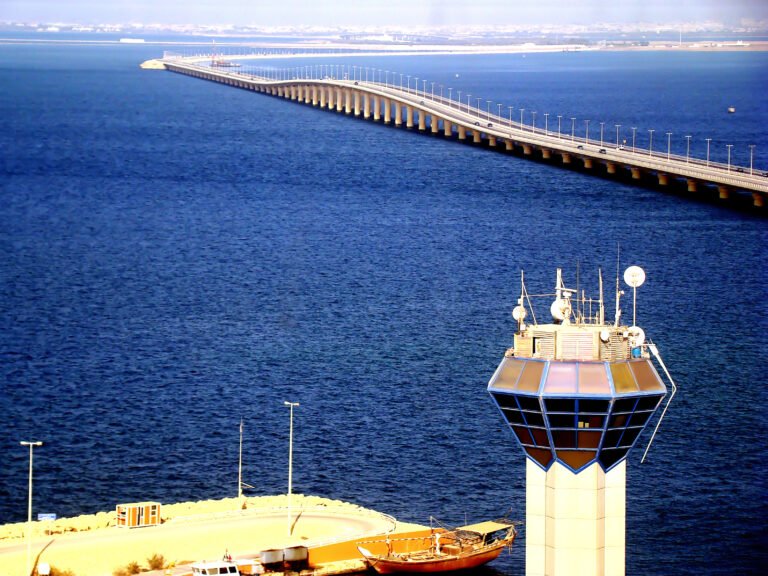
Driving via the King Fahd Causeway

For those who prefer to bring a vehicle or simply dislike flying for a short hop, the King Fahd Causeway connects Bahrain to the Eastern Province of Saudi Arabia, from where it is a substantial road journey west to Riyadh and on to Qiddiya. This route takes considerably longer, generally most of a day depending on causeway processing times and road conditions, so it suits travellers who see the drive itself as part of the weekend rather than a means to an end. If you take this option, build in a buffer for causeway queues, particularly around public holidays and long weekends when crossing volumes rise sharply.

Whichever route you choose, arranging a private vehicle for the Riyadh-to-Qiddiya leg in advance, rather than assuming you can pick one up on arrival, is the single most reliable way to protect a short weekend from being eaten up by transport delays.

King Fahd Causeway connecting Bahrain and Saudi Arabia

Planning a Two Day Itinerary

A weekend trip works best when the itinerary is realistic rather than packed. A typical pattern for a Thursday evening arrival and Saturday departure looks like this: settle in and have dinner on the first evening, spend the full first day exploring Qiddiya’s attractions and venues at a comfortable pace, then use the second morning for anything you missed or a relaxed breakfast before the return journey. Trying to combine a Qiddiya visit with a full Riyadh city itinerary in the same weekend usually means neither gets the time it deserves, so it is worth being selective rather than ambitious.

If your group includes children or older relatives, build in more rest time between attractions than you think you need. Saudi Arabia’s climate, particularly outside the cooler winter months, makes midday activity more tiring than the same schedule would be at home, and a rushed itinerary tends to produce a tired, irritable group by the second afternoon.

It is also worth deciding in advance whether you want a single vehicle for the whole weekend or separate transfers for each leg. For a family or small group, booking one vehicle at your disposal for the full day, rather than several separate point-to-point transfers, is often more convenient and can work out more cost-effective once waiting time and multiple pickup coordination are factored in.

What to Book Before You Travel

A smooth Bahrain-to-Qiddiya weekend usually rests on three bookings made before you leave home: your flight or causeway crossing, your accommodation near Qiddiya or in Riyadh, and your ground transport for both the airport transfer and any local movement around Qiddiya itself. Leaving the transport booking until arrival is the most common reason a short weekend trip starts badly, since taxi availability at unfamiliar pickup points can be inconsistent, particularly late in the evening.

Confirm your booking includes the driver’s name and vehicle details in advance, so you can verify the match at the pickup point rather than guessing. If you are travelling with young children, request a vehicle with an appropriate child seat when you book, since this is far easier to arrange ahead of time than to source on the day. GCC residents should also check current entry and identification requirements before travelling, since arrangements can differ from a standard international visit; the Saudi Tourism Authority publishes current visitor guidance, and it is worth a final check shortly before you travel rather than relying on what was true on a previous trip.

Desert highway road leading toward Riyadh Saudi Arabia

Frequently asked questions

Q: Is a weekend really enough time to visit Qiddiya from Bahrain? A: Yes, provided you fly rather than drive the full distance and keep the itinerary realistic. A Thursday evening departure and Saturday or Sunday return gives a genuinely useful day and a half on the ground.

Q: Should I book a return transfer in advance or arrange it once I land? A: Book in advance. A confirmed vehicle waiting at arrivals removes one of the biggest sources of delay on a short trip, particularly late at night.

Q: Is the King Fahd Causeway a realistic option for a weekend trip to Qiddiya? A: It can be, but the driving distance from the causeway to Qiddiya is substantial, so it suits travellers who want the drive itself to be part of the weekend rather than those trying to maximise time on the ground.

Q: Do I need a separate vehicle for each day, or can I book one driver for the whole trip? A: Booking one vehicle at your disposal for the full day is usually more convenient for a family or small group than arranging separate point-to-point transfers each time you want to move.

Q: What should I check before I travel as a GCC resident? A: Confirm current entry and identification requirements shortly before departure, since simplified GCC arrangements can still have specific documentation requirements that are worth checking close to your travel date.

Related guides

Checked sources


If you would like a fixed-price transfer arranged for a weekend trip to Qiddiya, Saudi Cab Co can meet you at Riyadh’s airport and take care of transport for the whole visit. Get in touch before you travel and we will match your booking to exactly what you need.

Solo Business Travellers: Booking Transport for a First Trip to Saudi Arabia

Reviewed travel guidance. This article is general planning guidance for visitors arranging ground transport in Saudi Arabia. Always check current entry requirements and airline policies before you travel.

Travelling to Saudi Arabia alone for the first time on business brings a different set of planning questions than a group trip or a family holiday. There is no colleague to double check the pickup point, no travel desk relaying updates in real time, and every hour lost to uncertain transport is an hour taken away from meetings, calls or preparation. Getting the ground transport plan settled before you leave home removes one of the biggest sources of first-trip stress. This guide sets out what a solo business traveller visiting Saudi Arabia for the first time should organise in advance, from airport arrival through to getting between meetings, so the trip runs on your schedule rather than around whatever transport happens to be available on the day.

Before you fly: what to arrange in advance

A solo trip rewards preparation more than a group trip does, simply because there is nobody else to catch a mistake. Before you travel, confirm your entry requirements are in order and check current guidance rather than relying on secondhand advice from colleagues who may have travelled under different rules. The UK Foreign, Commonwealth and Development Office publishes up to date travel advice for Saudi Arabia covering entry requirements, safety and local laws, and it is worth a final check close to your departure date rather than weeks before.

It is also worth building your working week around the local calendar rather than assuming it matches home. The Saudi working week runs Sunday to Thursday, with Friday and Saturday forming the weekend, and the country operates on Arabia Standard Time, three hours ahead of GMT. Confirming this before you book calls or set meeting expectations avoids the awkward discovery, mid-trip, that a contact you assumed would be reachable on a Sunday is actually mid-week busy, or that a Friday you planned to use for a client visit is a public holiday for your hosts.

Once your paperwork and calendar are sorted, turn to the practical side of the trip. A few things are worth locking in before you fly:

  • Your airport pickup, booked against your actual flight number rather than an estimated arrival time.
  • A saved copy of your hotel address and any meeting venue addresses, ideally in both English and Arabic script.
  • A local contact number for your driver or transport provider, so you are not relying solely on hotel Wi-Fi or airport signal on arrival.
  • A rough outline of which days you will need city transport versus intercity transport, so you are not arranging bookings on the fly mid-trip.
  • A local SIM or data plan sorted before you land, so you can reach your driver and check addresses the moment you switch your phone on.

Solo travellers benefit more than most from having this settled ahead of time, because there is no shared itinerary to fall back on if something goes wrong. A group trip can absorb one person’s missed connection or wrong turn; a solo trip has no such buffer, so the planning has to do the work that a travel companion would otherwise provide.

Landing alone: what to expect at the airport

Arriving on your own for the first time can feel disorientating even for experienced business travellers, simply because the airport layout, signage and pace are unfamiliar. Saudi Arabia’s major airports, including King Khalid International in Riyadh, King Abdulaziz International in Jeddah and King Fahd International in Dammam, have expanded significantly in recent years, and terminal layouts can differ from what you might expect, so it helps to know roughly where you are heading before you land rather than working it out after a long flight. The General Authority of Civil Aviation publishes current information on Saudi airports, including terminal operations, at gaca.gov.sa, which is a useful reference if your itinerary involves an airport you have not used before.

Solo business traveller with a suitcase walking through an airport arrivals area

A pre-booked driver holding a name board removes the need to work out taxi ranks, currency or negotiation on arrival, which matters more when you are travelling without a colleague to share the decision with. Confirm in advance where exactly your driver will meet you, since some terminals separate arrivals by airline or flight type, and a vague “meet at arrivals” instruction can cost you time you would rather spend getting to your hotel and settling in. If your flight lands late in the evening, it is also worth confirming that your provider tracks flight status directly, so a delay on your side does not leave a driver waiting at the wrong time or, worse, leave you waiting for a driver who assumed you had already landed.

Choosing the right vehicle and booking method

Solo business travel does not need a large vehicle, but it does benefit from predictability. A fixed-price, pre-booked transfer means you know the cost and the vehicle before you land, rather than negotiating on the spot or relying on an app with variable pricing at a moment when you are tired and unfamiliar with the local rate. This matters particularly on a first trip, when you have no baseline for what a fair fare should look like, and no colleague nearby to sanity check a price that seems unusually high.

A standard sedan is normally the right choice for one traveller with a carry-on case and a laptop bag, but it is worth flagging anything unusual when you book, such as a garment bag for a formal event, product samples, or display materials for a conference stand. Providers can allocate a larger vehicle in advance far more easily than they can swap one out on short notice at the kerb.

When booking, it is worth deciding upfront whether you need:

  • A single point-to-point transfer for a short trip focused on one city.
  • A day rate or multi-stop arrangement if your schedule includes several meetings across one day.
  • Return transfers booked together, so your departure transport is confirmed before you even land, not arranged reactively near the end of the trip.

Booking your transport as a package rather than trip by trip also reduces the number of separate decisions you need to make while you are focused on work. A solo traveller juggling meetings, time zones and an unfamiliar city benefits from having transport be the one part of the day that requires no thought at all.

Getting between meetings as a single traveller

Saudi Arabia’s business centres are spread across cities that are not always designed for walking between appointments, and taxi availability outside pre-booked services can be inconsistent depending on location and time of day. Riyadh’s business district around Olaya and King Fahd Road, for example, can involve longer distances between office towers than the map suggests, and a meeting that looks a short hop away may in practice take considerably longer at certain times of day. For a solo traveller with back-to-back meetings, waiting on the street for an available taxi is a genuine risk to your schedule, not just an inconvenience.

A pre-arranged driver who can wait between appointments or return at a set time removes this risk. It also means you are not spending mental energy mid-meeting wondering how you will get to the next one. If your day involves multiple stops, tell your transport provider the full sequence in advance rather than booking each leg separately, since a driver working from a complete schedule can plan routes and timing more reliably than one receiving requests one at a time. It is also worth building a short buffer into back-to-back bookings, since meetings in any country can overrun, and a driver briefed on your full day can absorb a delay far more gracefully than one booked for a single fixed slot.

Business traveller checking a smartphone itinerary beside a car on a Saudi city street

Safety, trust and staying in control of your schedule

Travelling alone means you are the only person managing your own safety net, which makes vetting your transport provider more important than it might feel on a group trip where responsibility is shared. Before booking, check that a provider offers licensed drivers, a fixed and confirmed price, and a direct contact number you can reach if plans change. Avoid arrangements where the price or the driver is not confirmed until the last moment, since that uncertainty is exactly what a solo traveller can least afford.

It is also worth telling someone back home your outline schedule, including where you expect to be and roughly when, as ordinary good practice for solo travel anywhere. This is separate from your transport booking but works well alongside it: a confirmed itinerary of pickups and destinations gives you a clear paper trail of where you should be at any given time during the trip. Keeping a copy of your driver’s contact details and booking confirmations somewhere accessible, rather than buried in an email you might not be able to open, is a small habit that pays off if your phone runs low on battery or signal drops during a long day of meetings.

Building a simple itinerary around fixed transport

The easiest way to keep a solo business trip manageable is to build your daily plan around your transport bookings rather than the other way round. Once your airport transfer, hotel-to-meeting transfers and departure transfer are all confirmed, the rest of your itinerary can flex around fixed points rather than depending on transport being arranged reactively.

A simple structure that works well for a first-time solo visitor:

  • Airport to hotel, booked against your flight number with some buffer for immigration and baggage.
  • Hotel to each meeting or venue, confirmed the evening before with exact addresses.
  • A return leg booked at the same time as the outbound leg, so you are not arranging it under time pressure at the end of a long day.
  • Departure transfer to the airport, booked with enough buffer for check-in and security, particularly if your final day includes a last meeting.

For a short two or three day trip, it can help to sketch out each day the evening before you fly, noting roughly what time each meeting starts and how far apart they are, so your transport bookings can be confirmed as a set rather than pieced together once you have already landed. Treat your transport plan the same way you would treat your meeting schedule: confirmed in writing, in advance, with no gaps you are hoping to fill in on the day.

Frequently asked questions

Q: Is it safe to travel to Saudi Arabia alone for business as a first-time visitor? A: Many business travellers visit Saudi Arabia alone without issue. Check the latest guidance from your government’s foreign travel advice service before you go, and arrange trusted, pre-booked transport rather than relying on informal arrangements after you land.

Q: Should I book my airport transfer before I arrive? A: Yes. Booking your pickup against your actual flight number before you travel means a driver is waiting for you on arrival, which removes the need to work out local transport options after a long flight with no colleague to help.

Q: What vehicle size do I need as a solo traveller? A: A standard sedan is normally sufficient for one traveller with typical business luggage. You only need to consider a larger vehicle if you are carrying significant equipment or samples for your trip.

Q: Can I book a driver to wait between meetings on the same day? A: Yes, many providers offer day-rate or multi-stop bookings where a driver waits or returns at set times. This is usually more reliable for a packed schedule than booking each leg separately.

Q: How do I know a transport provider is trustworthy if I am travelling alone? A: Look for licensed drivers, a fixed price confirmed before the trip, and a direct contact number you can reach at any point. Avoid any arrangement where the price or driver assignment is only confirmed after you arrive.

Q: Should I confirm return and departure transport in advance too? A: Yes. Booking your return and departure transfers at the same time as your arrival transfer means your whole trip is covered before you land, so you are not arranging transport reactively while trying to focus on meetings.


If you would like a fixed-price quote tailored to your itinerary, Saudi Cab Co can arrange the right vehicle for your trip in advance. Get in touch before you travel and we will match your booking to exactly what you need.

Domestic Flights vs Private Intercity Transport: Which Makes Sense for Your Trip

Reviewed travel guidance. This article is general planning guidance for visitors arranging ground transport in Saudi Arabia. Always check current entry requirements and airline policies before you travel.

Saudi Arabia’s cities are spread across a large country, and most trips between them come down to a simple choice: book a domestic flight or arrange private intercity road transport. Both are genuinely viable options depending on the route, the group size and how the day is structured around the journey. Business travellers juggling a packed itinerary, families moving between cities for a holiday and GCC residents visiting relatives in another region all weigh this decision differently, because the right answer depends on more than just the distance on a map. This guide sets out the practical factors that should drive the decision, rather than assuming one option always wins.

How the distances actually compare

Saudi Arabia is roughly the size of Western Europe, so the right mode of transport depends heavily on which two cities are involved. Riyadh to Jeddah is around 950 kilometres, which puts it firmly in flight territory for most travellers, though a private car remains an option for those who want to see the country along the way or who are already road tripping. Shorter city pairs, such as Riyadh to Dammam or Jeddah to Taif, sit in a middle zone where either mode can work well depending on flight schedules and how much luggage or how many stops are involved.

Before booking anything, it is worth mapping out the actual point to point distance and the road route, not just the straight line distance a flight covers. A drive that looks short on a map can take considerably longer once terrain, town centres and rest stops are factored in. The road between Jeddah and Taif, for example, climbs through mountainous terrain, so the drive time reflects the incline rather than the straight line distance between the two cities. Knowing this in advance helps set realistic expectations for either mode, rather than comparing a flight time against a road distance that turns out to take longer than expected.

When a domestic flight is the better choice

Flying tends to make the most sense in a few clear situations.

  • The two cities are more than around 500 kilometres apart, where flight time saves several hours over driving.
  • You are travelling alone or as a couple, so the per-person cost of a flight is competitive with fuel and driver time for a long road journey.
  • Your schedule is tight and a missed afternoon meeting or connection would be costly, since flights are generally more predictable for a fixed block of travel time.
  • You have already checked baggage through to a connecting flight and want to avoid handling it again.
  • You are travelling on one of the busier trunk routes, where frequent daily departures make it easy to shift to an earlier or later flight if plans change.

Saudi Arabia has a well developed domestic route network connecting its main cities, and the General Authority of Civil Aviation publishes regulatory information for air travel in the Kingdom that is worth checking if you are unfamiliar with the current airline and airport landscape. For business travellers with back to back meetings in different cities on the same trip, a short flight often remains the fastest way to move a full working day’s worth of distance, provided the schedule leaves a sensible margin either side of the flight itself.

Passenger looking at a departures board at a Saudi domestic airport terminal

When private intercity transport makes more sense

Road transport has advantages that a flight simply cannot replicate, particularly once you look past the raw travel time comparison.

  • Door to door convenience. A private vehicle collects you from your hotel or home and drops you directly at your destination, with no airport transfer at either end.
  • No check in buffer. Domestic flights still require arriving with time to spare for security and boarding, which can add well over an hour to the total journey once you account for both ends of the trip.
  • Group and family travel. For three or more people, the combined cost of individual flight tickets often exceeds a single vehicle booking, especially on shorter routes.
  • Flexible stops. A road journey can include a stop for prayer, a meal or a scenic detour without disrupting a fixed flight schedule.
  • Luggage without restriction. There is no cabin allowance or checked bag limit to plan around when the whole boot is available.
  • Predictable pricing. A private vehicle booking is quoted as a single fixed price for the route, so there is no separate charge for extra bags, seat selection or last minute fare changes.

Routes such as Riyadh to Jeddah are still driven privately by travellers who value the flexibility of a fixed departure time and a direct route, and Saudi Cab Co runs this corridor from 798 SAR. Shorter, more regional routes, including connections around the Eastern Province such as Dammam Airport to Khobar from 120 SAR, are natural candidates for road transport since the flight time saving over a 45 minute drive is minimal once airport procedures are included. On these shorter regional hops, the time spent reaching the airport, clearing security and waiting to board can add up to more than the drive itself.

Working out the real total journey time

The comparison that matters is not “flight time versus drive time” but the full door to door duration for each option. For a flight, add the journey to the departure airport, the recommended arrival buffer before boarding, the flight itself, deplaning and baggage collection, and the transfer from the arrival airport to your final destination. For a private vehicle, the whole journey is the drive time plus any stops you choose to make.

On a route of two to three hours by road, this full calculation often narrows the time gap considerably, and on some routes road transport works out faster once every stage is added up. As an illustration, a one hour flight can easily become a three to four hour undertaking once both airport journeys and the standard boarding buffer are included, which is roughly the same total time as driving a mid length route directly. On longer routes of five hours or more by road, flying usually keeps a clear time advantage even after the airport steps are included, since no amount of added buffer time closes a gap of that size.

Cost, comfort and who is travelling

Cost comparisons should be made per trip, not per ticket. A domestic flight is often the cheaper option for a solo traveller on a longer route, but a private vehicle for a family or small group can work out more economical overall since the price is fixed for the vehicle rather than multiplied per passenger. Comfort also varies by traveller. Business travellers who need to work during the journey, take calls or review documents may prefer the privacy of a car. Families with young children, older relatives or anyone who finds airport processes stressful often find a direct road journey considerably more relaxed, since there is no need to navigate security queues or manage a toddler through a boarding gate.

It is also worth thinking about what happens at the far end of the trip. A flight gets you to an airport, and unless that airport is your final destination, you will still need onward transport into the city. A private intercity booking removes that second step entirely, which matters most when your destination is not close to the arrival airport, or when you are arriving late in the evening and would rather not arrange a separate transfer after a long flight.

Private car driving on an open Saudi Arabian intercity highway

Combining both on a longer itinerary

Many multi city trips do not need to be one mode or the other for the whole journey. A common pattern for business and leisure travellers alike is to fly the long leg between distant cities, such as Riyadh and Jeddah, and then use private road transport for shorter regional connections once they land, for example onward to Madinah or across to AlUla. This combination gets the time saving of flying where distance genuinely calls for it, while keeping the flexibility of a private vehicle for legs where road transport is naturally more convenient. It also spreads the travel across the trip rather than concentrating it into one long day, which tends to suit families and anyone travelling with older relatives.

If your itinerary spans several cities over a week or more, it is worth mapping each leg separately rather than defaulting to one mode of transport for the whole trip. A single long flight combined with two or three shorter private transfers is often more comfortable, and sometimes cheaper overall, than either booking every leg as a flight or driving the entire route end to end. Before finalising plans, check the Saudi Tourism Authority’s visitor planning resources for up to date information on getting around the country, and review the GOV.UK travel advice for Saudi Arabia or the equivalent US State Department advisory for current entry and safety guidance relevant to your nationality.

Frequently asked questions

Q: Is it cheaper to fly or drive between Saudi cities? A: It depends on group size and distance. Solo and long distance travel often favours flying, while families, small groups and shorter regional routes often work out more economical by private vehicle since the price is fixed per vehicle rather than per passenger.

Q: How much time should I allow for a domestic flight compared with the flight time itself? A: Add time for getting to the airport, the recommended check in and security buffer, and onward transport at the arrival end. On short routes this buffer can equal or exceed the flight time itself, so it is worth calculating the full journey rather than just looking at the scheduled flight duration.

Q: Is private road transport safe for long distances in Saudi Arabia? A: Saudi Arabia has a modern national highway network connecting its major cities. Booking with a licensed provider and choosing a vehicle suited to the distance and group size is the main practical consideration for a long road journey.

Q: Can I combine a flight with private transport on the same trip? A: Yes, this is common on multi city itineraries. Many travellers fly the longest leg between distant cities and use a private vehicle for shorter regional connections either side of the flight.

Q: Does private transport make more sense for business travellers? A: Often, particularly on shorter routes or when back to back meetings mean avoiding airport processes altogether saves time. It also allows work to continue during the journey itself, which is harder to do on a short domestic flight.

Q: What is the shortest route where a flight still makes sense? A: There is no fixed distance rule, since it depends on flight schedules, group size and how much value you place on door to door convenience. Comparing full journey time for both options on your specific route is more useful than a general distance cut off.


If you would like a fixed-price quote tailored to your itinerary, Saudi Cab Co can arrange the right vehicle for your trip in advance. Get in touch before you travel and we will match your booking to exactly what you need.

Cross-Border Travel for GCC Nationals: Transport Options Explained

Crossing into Saudi Arabia by land

GCC nationals travelling to Saudi Arabia have an option that international visitors do not: crossing by land, often using a GCC national ID card rather than a passport, depending on the crossing and current entry rules. This guide looks specifically at the transport side of that journey, from the border crossing itself through to onward travel once inside Saudi Arabia. It does not replace official entry requirement guidance, which travellers should always confirm before departure.

Satellite view of the King Fahd Causeway between Bahrain and Saudi Arabia

The main land crossing points

King Fahd Causeway, from Bahrain

The King Fahd Causeway is the best known GCC land crossing, connecting Bahrain to the Eastern Province of Saudi Arabia near Khobar and Dammam. It is a well established route for both day visitors and longer stays, and is typically used by private vehicle, taxi, or a scheduled bus service that operates across the causeway.

Land borders with the UAE, Kuwait, Oman, and Qatar

Saudi Arabia also shares land borders with the UAE, Kuwait, and Oman, each with formal crossing points used regularly by GCC nationals travelling by private vehicle. The land border with Qatar has a more complex recent history and travellers should always verify current status before planning a crossing there, rather than assuming it operates as it did in the past.

What changes once you are across the border

A land border crossing is only the first leg of the journey. GCC nationals arriving by causeway or land border into the Eastern Province, for example, still need onward transport to reach Riyadh, Jeddah, or wherever their final destination is, and that distance can be substantial. Dammam and Khobar sit a considerable distance from Riyadh, and an even greater distance from Jeddah on the west coast, so it is worth planning the whole route rather than just the crossing itself.

Onward transport options after crossing

  • Pre-booked private transport waiting on the Saudi side of the crossing, avoiding the need to arrange transport after a long drive
  • Self-drive, if arriving by private vehicle and continuing the same journey
  • A domestic flight from Dammam onward, for GCC nationals crossing the causeway but travelling on to a distant city such as Jeddah
Riyadh business district, a common onward destination after a GCC land crossing

Practical considerations specific to GCC travellers

Peak crossing times

The King Fahd Causeway in particular sees significant weekend and holiday traffic, with queues that can extend processing time well beyond a typical weekday crossing. Travellers planning a land crossing around a public holiday or a long weekend should build in extra time and, where possible, avoid the busiest crossing windows.

Vehicle documentation

Travellers crossing by private vehicle should confirm current requirements for vehicle insurance and registration recognised across the border, since these can differ from requirements for a vehicle used only domestically.

Family and group travel

GCC nationals frequently cross for family visits or extended stays with multiple relatives travelling together. For this kind of trip, arranging pre-booked transport for the onward leg, sized correctly for the group and luggage, removes one of the more stressful parts of an already long travel day.

Booking onward transport in advance

For anyone crossing a Saudi land border and continuing to a city some distance away, arranging the onward leg before departure is worth the extra planning. A driver waiting at an agreed point after the crossing, briefed on the pickup location and timing, turns what can otherwise be an uncertain final stretch into a straightforward, predictable end to the journey.

First-time crossers versus regular travellers

A GCC national crossing into Saudi Arabia for the first time faces a slightly different set of practical questions to someone who makes the trip regularly. Regular crossers usually already know the typical queue patterns, the fastest lanes, and how long the onward journey genuinely takes. First-time crossers benefit from asking a transport provider or a previously travelled family member for realistic timing expectations before departure, rather than estimating based on the straight-line distance alone, since actual crossing and processing time can vary considerably depending on the day and time chosen.

Peak holiday crossing patterns

Land border crossings, and the King Fahd Causeway in particular, see especially heavy use around Gulf public holidays and long weekends, when family visits across the border spike sharply. Travellers planning a crossing around one of these periods should expect processing times well beyond a normal weekday crossing, and should treat the crossing itself as a significant portion of the day’s schedule rather than a brief formality on the way to the real destination. Building in a wide time buffer, and confirming onward transport pickup times with some flexibility rather than a fixed minute, helps absorb this kind of unpredictable delay without disrupting the rest of the trip.

Return crossings and re-entry

GCC nationals travelling for a short visit often underestimate the return leg, particularly if it falls at the end of a weekend or holiday period when the causeway or land border crossing is at its busiest. Building extra time into the return journey, and confirming return transport to the border crossing point in advance rather than arranging it at the last minute, avoids the return trip becoming the most stressful part of an otherwise straightforward visit.

Costs to budget for

Beyond the transport itself, GCC travellers crossing by land should budget for any applicable crossing fees, which can apply per vehicle at some crossings, and for fuel if driving privately across a longer stretch of Saudi territory after entry. Travellers relying on pre-booked transport for the onward leg should get a clear all-in quote before departure, covering the full distance to their final destination, rather than assuming a single flat rate applies regardless of how far they are travelling from the border.

Combining a border crossing with a longer Saudi stay

Some GCC nationals use a land crossing as the start of a longer trip across Saudi Arabia, rather than a short visit to the border city alone. In this case, it is worth planning the whole route in one go, including any onward flights, intercity road transport, and the return crossing, rather than treating each leg as a separate booking made as you go. A single trip plan covering the crossing, onward travel, and the return journey gives a clearer overall picture of timing and cost, and avoids the situation where a later leg of the trip is booked in a rush because it was not considered until the traveller was already on the road.

Documents worth keeping accessible throughout

Whether travelling by land border or connecting onward by air within Saudi Arabia, it is sensible to keep GCC identification, any vehicle documents if driving privately, and onward booking confirmations easily accessible rather than packed away, since these may be requested more than once across a longer multi-leg journey.

A note on business travel across GCC borders

Alongside family visits, GCC nationals regularly cross into Saudi Arabia for business, particularly between the Eastern Province and the wider Gulf business hubs. For this kind of trip, the same planning principles apply, but with less tolerance for delay: a pre-booked driver waiting at an agreed point after the crossing, briefed on a specific meeting time, is generally worth arranging even for a single day trip, since a delay at the border on a tight business schedule has a much higher cost than the same delay on a leisure visit with no fixed appointment to reach.

Related guides

Checked sources

Family Reunions and Domestic Travel: Booking Transport Across Saudi Arabia

Reviewed planning guidance. This article offers general planning guidance for coordinating family transport within Saudi Arabia; travellers should confirm current entry requirements and any location-specific details with official sources before travelling.

Extended families scattered across the Gulf, the UK, and further afield increasingly use Saudi Arabia as a meeting point, whether that is a wedding in Jeddah, a family reunion timed around a school holiday, or GCC residents converging on relatives in Riyadh or Dammam. The logistics are rarely simple: different flights landing hours apart, grandparents who need a gentler pace than younger relatives, and more luggage than a single car can hold. This guide is for anyone organising ground transport for a multi-generational family gathering in Saudi Arabia, whether the group is arriving from overseas or driving in from a neighbouring GCC country.

Why family reunion transport needs its own plan

A standard airport transfer assumes one flight, one pickup point, and a handful of passengers. Family reunions rarely work that way. You might have a sibling flying in from London, parents driving up from Dammam, and cousins arriving on a red-eye from Dubai, all converging on the same house or hotel within a 48-hour window. Treating this as a single booking usually means someone waits two hours at the kerb, or two vehicles turn up when three were needed. Planning the transport as its own project, separate from the accommodation and the event itself, tends to save the most stress on the day.

The core challenge is coordination rather than distance. Riyadh, Jeddah, and Dammam are each well served by ground transport, so getting any single traveller from A to B is straightforward. The complexity comes from doing it for ten or fifteen people, several of whom do not know the city, do not speak Arabic, and are jet-lagged.

It also helps to think about the reunion in phases rather than as one event. The arrival phase, where people land at different times and need collecting, is usually the most complex to plan. The middle phase, once everyone is together and moving as a group to the wedding venue, the family home, or a shared outing, is comparatively simple because the group can often travel together in one or two vehicles. The departure phase, at the end of the reunion, tends to mirror the arrival phase in complexity, with flights leaving at staggered times and some relatives extending their stay while others head home. Planning each phase separately, rather than assuming one transport arrangement will cover the whole visit, avoids a lot of last-minute scrambling.

Mapping arrivals before booking anything

Before contacting a transport provider, build a simple table of every traveller: arrival airport, date, time, flight number, and number of bags. This sounds basic, but it is the single most useful document for a family reunion. It exposes clusters (three flights landing within an hour of each other can often share a vehicle) and gaps (a lone arrival at 3am who will need a dedicated pickup regardless of cost).

  • List arrival city and terminal separately, since Riyadh, Jeddah, and Dammam each have distinct international and domestic terminals.
  • Note connecting flights, since a delayed first leg can shift a whole day’s pickup schedule.
  • Flag anyone travelling with children, older relatives, or mobility needs so the right vehicle is assigned in advance.
  • Confirm whether the destination is a single family home, one hotel, or several addresses across a city, since this changes how many drop-offs are needed.
  • Record a mobile number that will be reachable on arrival for every traveller or their nearest travelling companion, since this is what a driver will use to confirm pickup on the day.

Once the table exists, a transport provider can group pickups sensibly rather than treating each traveller as an isolated booking. It is also worth updating the table once flights are confirmed closer to travel, since airlines sometimes adjust schedules in the weeks before departure, and a stale table can quietly undo careful planning.

Vehicle sizing for larger families

Family reunion travel is one of the few scenarios where getting the vehicle size wrong is genuinely costly, not just inconvenient. A saloon car comfortably takes two passengers and their luggage; it will not take a family of five with suitcases, car seats, and gifts. For groups larger than four, a minivan or SUV is usually the minimum, and reunions involving ten or more people across multiple pickups often need two or three vehicles working in sequence rather than one oversized vehicle trying to do everything.

Practical points to think through when sizing vehicles:

  • Count suitcases separately from passengers. A family of four returning from a long trip abroad may have six or seven large bags between them.
  • If elderly relatives are travelling, prioritise a vehicle with easier entry and exit over one with marginally more boot space.
  • Ask whether infant or child seats need to be provided, and confirm this in advance rather than at the kerb.
  • If the family will split across the city for different nights (some at a hotel, some at a relative’s home), plan the vehicle allocation around destinations, not just headcount.
  • For celebrations that involve formal outfits, such as a wedding, factor in extra space for garment bags and boxed items that do not compress the way ordinary luggage does.
Extended family greeting each other after arriving for a reunion at a Saudi airport

Staggered arrivals and the waiting-time problem

The most common failure point in family reunion travel is the assumption that everyone can be collected at once. In practice, flights land at different times, sometimes across different days, and a driver asked to wait indefinitely at an airport kerb is neither efficient nor, in many cases, permitted for long unmanaged waits. A better approach is to book transfers per arrival cluster rather than per family, with a small buffer built in for immigration and baggage claim.

For visitors, entry procedures and any visa requirements should be checked against the official Saudi eVisa portal well before departure, since processing times and eligibility can affect how confidently an arrival time can be planned. Domestic and GCC travellers moving between cities within Saudi Arabia do not face this layer, but should still allow for the usual variability in flight timing and immigration queues at Saudi airports.

A workable staggered plan usually looks like this:

  • Group arrivals within a 60 to 90 minute window into a single pickup where the vehicle size allows.
  • Book separate transfers for arrivals more than two hours apart, rather than asking one driver to cover the whole span.
  • Build in a buffer of at least 45 minutes after scheduled landing time for international arrivals, to account for immigration and baggage.
  • Share a single point of contact number with the transport provider so drivers can confirm real-time arrival status rather than working from the original flight schedule alone.
  • For overnight or very early morning arrivals, agree in advance whether the family wants everyone taken straight to the accommodation or whether some travellers would prefer to wait at the airport for a later relative, since this changes how many separate vehicles are needed.

Domestic and GCC family travel: a different rhythm

Not every family reunion in Saudi Arabia starts with an international flight. Many GCC residents drive across borders, particularly from the UAE, Bahrain, or Kuwait, to visit relatives, and Saudi nationals frequently travel between cities such as Riyadh, Jeddah, Dammam, and Abha for the same reason. This kind of domestic movement tends to be more flexible on timing but no less demanding on vehicle capacity, especially around school holidays and public holidays when roads and hotels are busier than usual.

For domestic legs, the planning priorities shift slightly:

  • Intercity journeys benefit from booking a few days ahead during peak periods, since demand for larger vehicles rises sharply around holidays.
  • If the reunion spans several cities (for example, a few days in Riyadh followed by a trip to Jeddah), it is often more efficient to arrange a single provider for the whole itinerary rather than re-booking locally in each city.
  • Confirm whether the return leg is fixed or flexible, since family gatherings often run longer than planned and a rigid return booking can cause last-minute scrambling.
  • Where relatives are driving in from a neighbouring GCC country rather than flying, agree a meeting point in the destination city in advance, since coordinating a pickup for a car-based arrival works differently from an airport transfer and benefits from a clear, fixed address rather than a rolling estimate.

Practical booking tips for the whole group

A few habits make family reunion transport noticeably smoother, regardless of group size:

  • Appoint one family member as the single point of contact for all bookings, rather than having several relatives book separately and duplicate or miss pickups.
  • Ask for fixed, upfront pricing per journey so the family is not exposed to surge pricing during a busy arrival window.
  • Share the full traveller table (names, flights, luggage, needs) with the transport provider in one document rather than piecemeal messages.
  • Confirm driver contact details are shared in advance, particularly for late-night or early-morning pickups when phone signal or terminal exits can cause confusion.
  • Keep a small amount of flexibility in the schedule for the first day, since jet lag and immigration queues are the two most common causes of delay.
  • Where the reunion includes an event with a fixed start time, such as a wedding ceremony, build transport for that day around the event time working backwards, rather than assuming the morning’s arrivals will naturally leave enough room.
Minivan loaded with luggage ready to collect a family group from the airport

Frequently asked questions

Q: How far in advance should we book transport for a large family reunion? A: For groups of eight or more, or for reunions during school holidays or national holidays, booking two to three weeks ahead is sensible, since larger vehicles and multi-pickup coordination need more lead time than a single transfer.

Q: Can one provider handle pickups from different airports on the same day? A: Yes, a single provider can usually coordinate pickups across Riyadh, Jeddah, and Dammam on the same day, though this should be arranged as one coordinated booking with a shared traveller list rather than separate last-minute requests.

Q: What is the best vehicle for a family of six with luggage? A: A minivan or full-size SUV is usually the minimum for six passengers with standard luggage; for six people with heavy or oversized bags, two vehicles travelling together is often more comfortable than one overloaded vehicle.

Q: Do GCC residents driving across the border need different documentation for ground transport within Saudi Arabia? A: Ground transport booking itself does not require additional documentation beyond standard identification, but travellers should check current entry requirements for their nationality via official travel advisory sources before crossing.

Q: What happens if one relative’s flight is delayed but the rest of the group has already landed? A: Booking arrivals as separate transfers rather than one shared pickup avoids this problem entirely, since each traveller’s vehicle is matched to their actual flight status rather than a fixed group schedule.

Q: Is it cheaper to book one large vehicle or several smaller ones? A: It depends on the pickup pattern. If everyone lands within the same short window at the same airport, one larger vehicle is usually more cost-effective; if arrivals are spread across hours or airports, several smaller bookings timed to each flight tend to work out better overall, and having a single named contact coordinate the bookings usually prevents duplication either way.


If you are coordinating transport for a family reunion in Saudi Arabia, Saudi Cab Co can arrange fixed-price pickups across multiple arrivals, cities, and vehicle sizes from a single booking. Get in touch for a tailored quote and we will map the transport around your family’s actual arrival schedule, not the other way round.

GCC Resident Intercity Travel: Crossing Saudi Arabia for Family and Business

Reviewed planning guidance. Details can change; use the linked official sources and get a live quote for current pricing and availability.

For residents of the UAE, Bahrain, Kuwait, Qatar and Oman, Saudi Arabia is often less a foreign destination and more an extension of everyday life: a place to visit family, attend a wedding, close a business deal, or drive across for a long weekend. That familiarity can make it easy to under-plan the practical side of the trip, particularly the transport once you’re actually inside the country. Saudi Arabia is large, its cities are spread out, and the logistics of getting from an airport or border crossing to where you actually need to be deserve the same attention as the crossing itself.

Crossing into Saudi Arabia as a GCC resident

Entry rules and documentation requirements for GCC nationals and residents can differ from those for other visitors, and they are also the kind of detail that changes without much notice. Rather than relying on general advice, always check current requirements directly before you travel. For UK nationals and residents, gov.uk’s foreign travel advice for Saudi Arabia is the reference point; US citizens and residents should use travel.state.gov; and for the official Saudi position on visas and entry, visa.visitsaudi.com and visitsaudi.com are the primary sources. If you’re not a GCC national yourself but hold GCC residency, your entry requirements may differ from those of citizens of that same country, so it’s worth confirming your specific situation rather than assuming residency status alone covers you the same way.

If you’re planning the visa side of the trip in more depth, our guide to Saudi eVisa basics for business and leisure visitors is a useful starting point, though GCC-specific routes and any overland border arrangements should still be confirmed against the official sources above, since they can differ from the standard eVisa process covered there.

Overland versus flying between GCC countries and Saudi Arabia

Many GCC residents cross into Saudi Arabia by road rather than by air, particularly from the UAE, Bahrain and Qatar, where land or causeway routes are well established. Overland travel has its own considerations worth checking in advance: which border crossing you’ll use, whether your visa or entry permission specifically covers overland entry, and how long processing typically takes at that crossing. These details are worth confirming directly with official sources before you set off, since they can vary by crossing point and change over time.

Flying between GCC hubs and Saudi Arabia’s main airports, principally Riyadh and Jeddah, but also Dammam for those coming from the UAE, Bahrain or Qatar, is often the faster option for a shorter trip, even accounting for airport time on both ends. Which route makes more sense usually comes down to how much luggage you’re carrying, whether you’ll want a car once you’re there, and how far your final destination is from the nearest airport.

There’s also a middle option worth considering on shorter visits: flying in and arranging pre-booked ground transport at the other end, rather than either driving the whole distance or hiring a car locally. For a long weekend visiting family in one city, this often works out simpler than managing a hire car for a trip where most of the time is spent at a single address rather than moving around.

GCC residents who do choose to drive their own vehicle into Saudi Arabia should also confirm vehicle documentation and insurance requirements before setting off, since these differ from simply carrying a valid driving licence. Cross-border vehicle insurance in particular is worth confirming with your insurer directly, as domestic cover in your home country does not automatically extend across the border.

A highway sign showing distances between major Saudi Arabian cities

Intercity transport once you’re in the country

Saudi Arabia’s cities are genuinely far apart. Riyadh to Jeddah is roughly a nine hundred kilometre drive, and Riyadh to Dammam is a similar distance in the other direction. For most GCC residents visiting for family or business, this means the trip usually involves at least one domestic flight or a substantial road journey, on top of however you arrived in the country in the first place.

A few practical options worth weighing against each other:

  • Domestic flights between the major hub airports, generally the fastest option for city-to-city legs of more than a few hundred kilometres.
  • The Haramain High Speed Railway, which connects Jeddah, Makkah and Madinah, useful if your trip includes that western corridor specifically.
  • Pre-booked intercity transfers by road, which suit shorter hops between neighbouring cities or trips where you want door-to-door convenience without navigating an unfamiliar city yourself.
  • Self-drive, which works well if you’re comfortable with long desert motorway stretches and want full control of your route and stops.

Family visits often involve multiple stops, from an airport to a relative’s home, then on to another city for a second visit or a business meeting, and coordinating that with a single pre-booked provider tends to be simpler than switching between transport types at every stage.

Peak periods are worth planning around too. GCC residents crossing for family occasions often travel around the same public holidays as everyone else, which means flights, the Haramain railway and pre-booked transport all see higher demand at the same time. Booking your onward transport at the same time as your flights, rather than leaving it until you land, avoids the scramble that can come with arranging things last minute during a busy period.

Business trips that combine several cities

GCC-based professionals frequently combine a Saudi trip across more than one city: a meeting in Riyadh, a conference stop in Jeddah, perhaps a site visit near Dammam. Where the schedule is tight, transport reliability matters more than cost, since a missed connection or delayed pickup has knock-on effects for the rest of the itinerary. Our guide to planning transport around events in Saudi Arabia covers how to build a schedule around fixed appointment times, which applies whether the event in question is a conference or a string of client meetings.

A business traveller checking a phone itinerary beside a private vehicle at a Saudi airport

Family travel logistics worth planning ahead

Visiting family across the GCC often means travelling with relatives of different ages, luggage that accumulates as the trip goes on, and a schedule set by other people’s availability rather than your own. Pre-booking transport for the parts of the trip you can predict, an airport pickup, a transfer between two specific addresses, a return journey on a known date, removes one variable from a trip that already has plenty of moving parts. For the parts of the trip that are genuinely open-ended, keeping a reliable transport option on standby is usually more practical than trying to book everything rigidly in advance.

Vehicle size is worth thinking about before you book rather than after you arrive at the airport with more people and luggage than expected. Multi-generational family trips often need a larger vehicle than a standard saloon, particularly where older relatives are travelling and comfort matters more than speed. Confirming vehicle type at the time of booking, rather than assuming whatever turns up will be adequate, avoids an awkward conversation at the kerb with everyone already tired from the journey and keen to get to wherever the rest of the family is waiting.

Staying connected and prepared once you’re across the border

Practical basics matter as much as the transport itself. Having a working local SIM or roaming plan, knowing your accommodation address in a form a driver can use, and keeping a copy of your entry documentation accessible rather than buried in checked luggage all make the transition from border or airport to your final destination noticeably smoother. None of this is specific to GCC travel, but it’s easy to overlook precisely because the trip feels familiar rather than foreign, and familiarity is exactly what leads travellers to under-prepare for the small logistical details that make a real difference on arrival.

Frequently asked questions

Do GCC nationals need a visa to visit Saudi Arabia?
Requirements vary and can change, so check current rules for your specific nationality and residency status directly with visa.visitsaudi.com or visitsaudi.com before travelling.

Is entry different for GCC residents who aren’t citizens of a GCC country?
It can be. Residency status and citizenship are treated differently in some cases, so confirm your specific situation against the official sources above rather than assuming residency alone is sufficient.

What’s the best way to travel between Saudi cities on a GCC family visit?
It depends on distance and luggage. Domestic flights suit longer hops, the Haramain railway suits the Jeddah, Makkah and Madinah corridor, and pre-booked road transfers suit shorter distances or door-to-door convenience.

Can I cross into Saudi Arabia by road from a neighbouring GCC country?
Overland crossings exist from several GCC countries, but requirements and processing at each crossing point can vary and change, so confirm current details with official sources before you travel.

How far apart are Saudi Arabia’s main cities?
Considerably further than many visitors expect. Riyadh to Jeddah and Riyadh to Dammam are both roughly nine hundred kilometres, which is why most multi-city visits involve a flight or a substantial road journey.

Should I book intercity transport in advance for a family visit?
For the fixed parts of your trip, an airport pickup or a known transfer date, pre-booking removes a layer of uncertainty. Keeping a reliable option on standby for the open-ended parts of the visit is usually more practical than trying to lock in every detail beforehand.


Whether you’re crossing for a family visit, a business trip, or both in the same week, book a reliable ride with Saudi Cab Co for your intercity legs and get a fixed quote before you travel.

Weekend trips from Riyadh: getting there without the hassle

Reviewed planning guidance. Details can change; use the linked official sources and get a live quote for current pricing and availability.

Friday afternoon rolls around and the group chat starts up again. Someone suggests getting out of the city for the weekend. Someone else asks the same question that comes up every time: who’s driving, and how are we splitting up if we take more than one car? For a lot of Riyadh residents, that logistics conversation is the reason a good weekend plan quietly falls apart before it starts. It doesn’t need to. Riyadh sits close enough to a genuine heritage destination that you can leave after work on Friday and be back well before Sunday night, and with a bit more planning you can reach further afield too. The part that actually needs sorting out in advance isn’t the itinerary. It’s the transport.

Where you can actually reach in a weekend

Diriyah and At-Turaif, the obvious first stop

If you want a weekend trip from Riyadh that doesn’t involve an airport, Diriyah is the destination most people mean when they say it. It sits on the edge of the city, which is what makes it realistic for a half-day or full-day outing rather than a proper expedition. At its centre is At-Turaif, the mud-brick district that served as the original seat of the first Saudi state and the historic home of the House of Saud. UNESCO listed At-Turaif as a World Heritage Site, and the wider Diriyah area has been developed over recent years into a much bigger draw, with restaurants, cafes and walking routes built around the old town’s architecture.

What makes Diriyah useful for a weekend plan is that it works for almost any group. Couples treat it as an evening out with dinner built in. Families use the daylight hours to walk the old town before the heat picks up. Groups of friends often combine it with one of the newer dining or entertainment areas nearby and turn a single visit into most of a day. Because the details of what’s open, what’s ticketed, and what’s currently running as a seasonal event change fairly often, the most reliable source is visitsaudi.com, which keeps an up-to-date picture of the site and any events tied to it. Don’t rely on a blog post from last year for opening information. Check the current listing before you go, particularly if you’re planning around a specific evening or a group booking.

Further afield, when you have more than a day

Diriyah is the easy answer, but it isn’t the only one. If your weekend has a bit more room in it, either because you’re taking a Thursday off or because it’s a long weekend, other regions of Saudi Arabia are within reach. Some groups drive further out of the city towards the desert escarpments and canyon viewpoints that Riyadh’s surrounding landscape is known for. Others use a domestic flight to reach a region like AlUla, the Red Sea coast, or the mountains around Abha, turning what would be a long, tiring drive into a short hop that leaves more of the weekend free for the destination itself.

If a domestic flight is part of the plan, it’s worth checking GACA, the General Authority of Civil Aviation, for current airport and travel information rather than assuming schedules or procedures haven’t changed. The practical point for this article is simpler than any of that, though: whichever destination you pick, the trip has two ground-transport legs that need to happen reliably. One gets you from home to the airport or out of the city, and one gets you back again at the end. It’s that second leg, arranged in the middle of a weekend when everyone is tired and ready to be home, that tends to go wrong if it wasn’t sorted out beforehand.

Thinking about when to go, not just where

Riyadh’s climate plays a bigger role in weekend planning than people sometimes admit. Outdoor walking through a place like At-Turaif is a different experience at midday in July compared with a Friday evening in December, and groups who’ve done both tend to agree the cooler months make for a far more comfortable visit. That doesn’t mean summer weekends are off the table. It just means adjusting the plan, aiming for early morning or evening hours rather than the middle of the day, and building your transport timing around that rather than a fixed schedule you’d use in cooler weather. A driver who’s waiting for you at 9pm on a July evening is a much more comfortable arrangement than trying to find one at short notice after a hot day out.

Public holidays and long weekends are worth factoring in too. Diriyah gets noticeably busier around national holidays and during any period when the area is hosting a seasonal event, and the same goes for restaurants and attractions further afield. If your group is planning around a long weekend rather than a normal Friday-Saturday, it’s worth checking visitsaudi.com a little earlier than usual, since capacity and opening arrangements can shift during peak periods.

Historic mudbrick architecture typical of the Diriyah heritage area near Riyadh (wider view)

Why a return transfer beats sorting it out on the day

There’s a pattern that plays out often enough to be worth naming directly. A group heads out for the day with transport arranged one way, usually because someone drove or because a taxi was easy to find at the start of the trip. By the time they’re ready to come home, it’s evening, everyone’s tired, the group has grown or shrunk from the original plan, and finding a ride back suddenly takes much longer than expected. Demand for taxis near popular destinations spikes at exactly the times weekend groups want to leave, which is early evening and after dark. That’s also when prices tend to move around the most if you’re relying on an app that adjusts fares to demand.

Booking a return transfer before you leave Riyadh solves this in a fairly obvious way: you already know your ride home is coming, at a time you chose, at a price you agreed to before you left the house. There’s no standing around checking a phone for a nearby car, no negotiating with a driver who doesn’t want to make the trip back into the city, and no risk of your group being split across two or three different rides because nothing large enough was available. If your plans shift during the day, which they usually do, having a booking with a real operator gives you someone to actually call and adjust, rather than starting the search for transport from scratch.

There’s also a simpler point that’s easy to overlook: a return transfer means you don’t need anyone in your group to be the designated driver, watching the clock and staying alert for a drive that can take a couple of hours depending on where you’ve gone. Everyone in the car gets to actually be on the trip, not managing it. For a weekend that’s supposed to be about getting away from routine, that’s not a small thing.

Historic mudbrick architecture typical of the Diriyah heritage area near Riyadh (close-up detail)

Planning a group weekend trip that actually works

Decide on timing before you decide on anything else

The single most useful thing a group can do before a weekend trip is agree on departure and return times early, even loosely, rather than leaving it to the day. Diriyah in particular gets busy in the late afternoon and evening, when the heat has dropped and both residents and visitors are out. If your group wants a relaxed pace rather than queuing for parking or tables, an earlier departure on Friday or Saturday tends to work better than trying to arrive right when everyone else does. Whatever time you settle on, that’s the time to build your transport booking around, not the other way round.

Match the vehicle to the group, not the other way round

A group of two adults has very different needs from a family of six with a stroller, or eight friends who want to travel together rather than split across cars. Trying to squeeze a group into a vehicle that’s slightly too small, or booking two separate cars when one larger one would have kept everyone together, tends to cause more friction on the day than people expect. When you book through Saudi Cab Co’s booking form, you can specify group size and luggage so the vehicle sent actually matches the trip, rather than working it out after everyone’s already standing outside with bags.

Build in a buffer, especially for the return leg

Plans slip. A dinner runs long, the sunset views take longer to enjoy than expected, or the group simply isn’t ready to leave when the original plan said they would be. This is far less stressful when your return transfer was booked with a real operator you can contact to adjust the pickup time, rather than a walk-up taxi you were hoping to flag down. If there’s any chance your group’s schedule will move, it’s worth mentioning that when you book, so the return pickup can be treated as flexible rather than fixed to the minute.

Split the group without splitting the plan

For larger weekend groups, it’s tempting to let people arrange their own way there and back to keep things simple. In practice this usually means some people arrive late, some leave early, and the group spends the day only partly together. Booking transport for the whole group at once, even if that means two vehicles travelling together, keeps everyone on the same schedule and avoids the awkward moment where half the group is ready to go and the other half is still waiting on a ride. It also tends to work out simpler on cost, since one booking covering the group is easier to split than several people each arranging and paying for their own taxi.

Agree on the money before you leave the house

Cost disagreements are one of the quieter ways a good weekend trip turns sour. Someone assumes the fare will be split evenly, someone else expected to pay only for their own leg, and the conversation happens awkwardly at the end of a long day when nobody wants to deal with it. A fixed-price return transfer arranged in advance sidesteps most of this, because the total cost is known before anyone leaves Riyadh and can be divided however the group agrees, whether that’s evenly, by household, or by whoever’s turn it is to organise the outing. Get a quote through the Saudi Cab Co booking form when you’re still in the planning stage, so the number is on the table alongside the itinerary rather than surfacing as a surprise on the day.

Have a plan for children, elderly relatives and mobility needs

Family weekend trips often include people at very different stages of a day out, from toddlers who need a car seat to grandparents who tire more quickly than the rest of the group. Mentioning this when you book, rather than working it out on the day, means the vehicle and the timing can actually account for it. A group with young children, for instance, is usually better served by an earlier return time than one built around watching the evening lights come on at a site that’s still busy at 10pm.

Keep a note of practical basics

None of this replaces basic trip planning. If your weekend includes visiting sites with specific entry requirements or seasonal opening arrangements, check visitsaudi.com before you go rather than assuming last year’s information still applies. If your plans involve travel further afield with a flight leg, GACA’s site covers current airport procedures. And if anyone in your group is visiting from outside Saudi Arabia and needs to check entry requirements before a weekend trip, gov.uk’s travel advice for Saudi Arabia and the equivalent travel.state.gov guidance for US travellers are the sources worth checking rather than a forum thread. Getting the transport sorted is the easy part once the basics are covered.

Frequently asked questions

Do we need to book tickets for Diriyah and At-Turaif in advance?
Ticketing and entry arrangements for At-Turaif and the wider Diriyah area change from time to time, especially around seasonal events. Check the current details on visitsaudi.com before your trip rather than relying on older information, and plan your transport around whatever timing that confirms.

Is Diriyah walkable once we’re there, or do we need transport between different areas?
The historic At-Turaif district itself is generally explored on foot, but Diriyah as a whole has grown to include several separate areas with restaurants and attractions. Depending on how much of it you want to see in one visit, you may want your driver to wait or return at an agreed time rather than trying to cover everything in one walking loop.

How far ahead should we book a return transfer for a weekend trip?
Booking earlier in the week gives you the most flexibility on vehicle type and pickup time, particularly if your group is larger or you’re travelling on a weekend evening when demand is higher. Same-day bookings aren’t impossible, but they leave less room to match the right vehicle to your group.

Can Saudi Cab Co handle a group of six or eight travelling together?
Yes. Use the booking form to specify group size and luggage and you’ll be matched with a vehicle suited to the trip, whether that’s a larger single vehicle or two vehicles travelling together so the group isn’t split up during the day.

What if our return time changes during the day?
Contact Saudi Cab Co to adjust the pickup time rather than assuming the original booking is fixed. This is one of the main advantages of booking a return transfer over relying on a walk-up taxi, since there’s a real point of contact if your plans shift.

Are there weekend destinations from Riyadh besides Diriyah that don’t require flying?
Diriyah is the clearest option for a straightforward day or evening trip without flying, and it’s the one most people mean when they talk about a Riyadh weekend break. Some groups also drive further out to see the desert landscape around the city. For anything further afield, such as AlUla, the Red Sea coast, or the southern mountains, a domestic flight is usually the more practical route given the distances involved, and GACA’s site has current airport information for planning that leg.

Checked sources

Official information for your planning

Transport, airport, visa and visitor arrangements can change. These official sources are provided so you can check the current position for your journey. Checked 2026-07-25.

If a weekend trip is already on the calendar, the transport is the one part worth locking in early rather than leaving to the day itself. Book a return transfer through Saudi Cab Co before you set off and the only thing left to plan is what you actually want to do when you get there.

Book a journey