

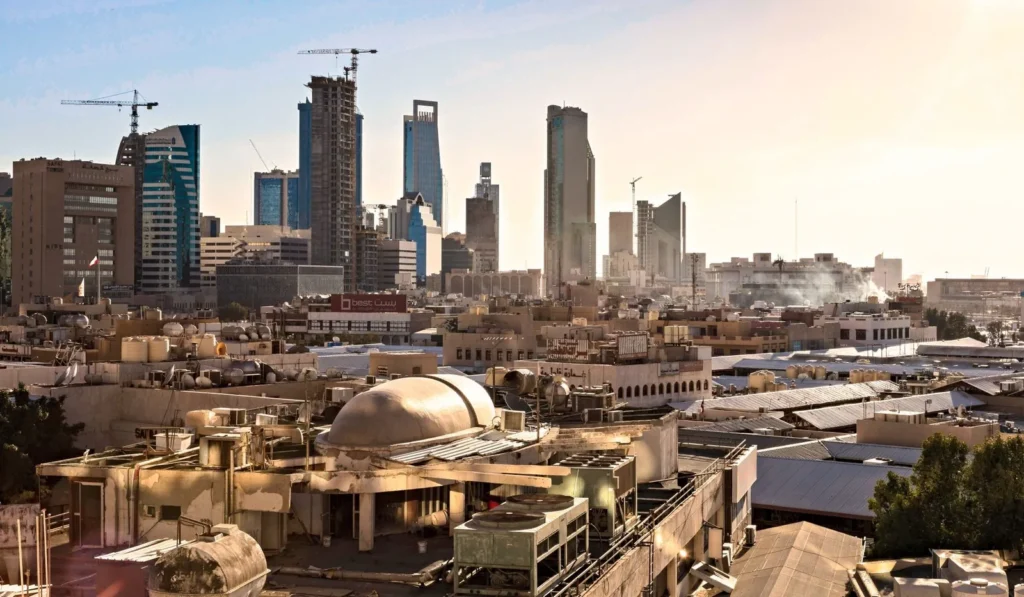
KAFD Riyadh transport comes down to three choices: the Riyadh Metro, which has its busiest interchange inside the district; a pre-booked car with a driver, which is the only option that takes you door to door between towers and then on to your next meeting; and your own two feet, because the King Abdullah Financial District was built to be walked. The right mix depends on what your day looks like. A single meeting near the metro station is one thing; a programme of four appointments in four buildings, a hotel check-in and an evening flight is another. This guide sets out how the district is laid out, how the metro and the planned monorail fit in, where a driver can and cannot stop, and how to plan a working day in KAFD without losing time at the kerb.
What is the King Abdullah Financial District and who is it for?
KAFD describes itself as a business and lifestyle destination in the heart of Riyadh. In its October 2024 monorail announcement, KAFD put the district at 1.6 million square metres with 95 buildings across five asset classes: Grade A offices, upscale residences, commercial and retail, luxury hospitality and entertainment venues. In a release dated 29 October 2025 it said the district had more than 140 office tenants and 19 regional headquarters. Banks, fintech firms, media companies and real estate groups make up much of that tenant list.
For a visiting professional, that means KAFD is where a growing share of Riyadh meetings now happen. If your counterpart works for a bank, an investment fund or a company that has moved its regional headquarters to Saudi Arabia, there is a fair chance the address you are given is a KAFD tower rather than an older office along Olaya Street. The district is also where several new hotels are opening, so it increasingly works as a base as well as a destination.
How is KAFD laid out?
The district sits in north Riyadh beside King Fahd Road and the Northern Ring Road. Its core is the Financial Plaza, which KAFD names as the commercial heart where tenants such as the Public Investment Fund, Saudi National Bank and Riyad Bank are based. A sunken wadi, a landscaped channel running through the district, provides the open space that many of the towers face, and a crescent of retail and dining wraps around part of it.
Two buildings are worth knowing by name before you arrive. The KAFD Grand Mosque, which won the King Salman Charter for Architecture and Urbanism Award in August 2024, is a landmark that drivers and receptionists use as a reference point. The KAFD Conference Center, managed by ASM Global since March 2024, hosts many of the district’s larger events, and the Hilton announced for the district will sit next to it, linked by climate-controlled skywalks. Those skywalks are a feature of the whole district: KAFD was planned so that buildings connect above street level, which matters a great deal in a city where summer afternoons are not for strolling outdoors.
Is there a KAFD metro station?
Yes, and it is one of the most important stations on the network. The Royal Commission for Riyadh City lists KAFD as one of four main hub stations on the Riyadh Metro, alongside Qasr Al-Hukm, Western and STC-Al-Olaya, and describes these hubs as intermodal interchanges where several metro lines and bus routes converge. The station was designed by Zaha Hadid Architects, whose project description records six platforms over four public levels, park-and-ride facilities, and a skybridge connecting to the planned KAFD monorail.
Three lines meet there. The Blue Line (Line 1) runs north to south along the Olaya and Batha corridor to Al-Hayer and is the line most visitors will use to reach central Riyadh. The Yellow Line (Line 4) follows King Khalid International Airport Road and links the district to the airport; KAFD is its terminus. The Purple Line (Line 6) runs east towards An Naseem. Riyadh Metro service began on 1 December 2024 with the Blue, Yellow and Purple lines, so KAFD has been connected from the first day of operation. The Royal Commission reported that the network spans 176 kilometres across six lines with 85 stations, and in November 2025 it announced a Guinness World Records entry as the world’s longest fully automated driverless metro network.
What this means in practice is simple. If you are staying anywhere along Olaya Street and your meeting is in a tower close to the station, the metro is a serious option. Tickets can be bought in the Darb app or at stations, and the system accepts contactless card payment. Operating hours and the current fare structure change from time to time, so check the Darb app or the Riyadh Public Transport site before you rely on a late train. We have not quoted hours here because we could not verify a current timetable on an official page at the time of writing.
What is the KAFD monorail and is it running?
On 30 October 2024, during the Future Investment Initiative, KAFD signed an agreement with a CRRC-led consortium including Hassan Allam Construction Saudi to build a driverless monorail inside the district. KAFD’s release describes a 3.6-kilometre circular track with six stations and six trains, integrated with the Riyadh Metro and intended to carry up to 3,500 passengers an hour at peak times. Its purpose is to move people between office buildings, retail and leisure venues across the district.
As of October 2026 we could not find an official announcement that the monorail has opened to the public, so treat it as a project under construction rather than a service you can plan around. KAFD’s own materials still refer to it as “upcoming”. When it does open, it should make the far side of the district much easier to reach from the metro station without a car. Until then, the practical choices for crossing KAFD are the skywalks, the pavements and a driver.
King Abdullah Financial District getting there by road: where can a car drop you?
This is where visitors most often lose time. KAFD is not a single building with a forecourt. It is a district of 95 buildings, several of them with their own basement car parks, access-controlled entrances and tenant-only parking. KAFD’s November 2023 parking announcement is instructive: the new shaded facility of more than 4,000 spaces is “primarily designated for the convenience of commercial tenants in the Financial Plaza”, access is by card, and a free shuttle bus runs from the car park into the Plaza. A visitor arriving in a hire car cannot assume there is somewhere to leave it near the right tower.
A pre-booked driver removes that problem, but only if the booking carries the right detail. Give the exact tower name and, if you have it, the building number or the name of the main tenant, rather than “KAFD”. Ask your host which entrance visitors use and whether the building has a lay-by, a basement drop-off or a security barrier where the car must stop short. Many towers do; the driver then waits in a holding area and comes back when you call. Share your phone number with the booking so the driver can confirm the pickup point by message if the entrance has changed.
If you are using a ride-hailing app instead, expect the pickup pin to be imprecise inside the district. Walk to a named landmark such as the metro station entrance, the Grand Mosque or a hotel porte-cochère before requesting the car, and set that as your pickup point.
Which hotels are inside KAFD?
The hotel picture has changed quickly. On 20 April 2026 KAFD announced the opening of W Riyadh – KAFD, with 210 rooms including 17 suites and two penthouses, seven restaurants and lounges and more than 1,000 square metres of event space, and with what the release calls direct access to the KAFD Metro. On 18 May 2026 KAFD announced Atheel, a Saudi-managed luxury business hotel of 214 rooms and suites on the corner of the district’s shopping crescent, overlooking the sunken wadi and “steps from KAFD Metro Station”, with opening set for the last quarter of 2026. Hilton Riyadh King Abdullah Financial District, a 450-room property with 900 square metres of meeting space, was announced on 29 October 2025 without an opening date, and InterContinental and Regent properties were announced in March 2024.
Check the current status of any hotel that is still “announced” rather than open before you book, and do not assume a hotel listed with a KAFD address is physically connected to the metro or the skywalk network until you have confirmed it. Staying in the district is attractive if all your meetings are there. If your programme is spread across Riyadh, a hotel on the Olaya corridor with a short metro or car hop to KAFD may serve you better; our guide to business transport in Riyadh compares the main hotel districts from a transport point of view.
KAFD Riyadh transport: metro or driver for your day?
The honest answer is that both have a place, and the mix changes with the shape of your day. The metro wins when you are travelling light, your meeting is in or near the Financial Plaza, and the time of day is sensible. It avoids the King Fahd Road traffic that builds on weekday mornings and it drops you into the heart of the district rather than at a barrier on the edge of it. We go through the trade-offs in detail in our comparison of the Riyadh Metro and a private transfer.
A driver wins when the day has more than one stop, when you are carrying luggage or presentation materials, when the afternoon heat is severe, or when a meeting is in a part of the district far from the station. It also wins when the schedule is fragile: if a meeting overruns, a waiting driver absorbs the delay, whereas a metro journey plus a walk plus a wait for a second car does not. For a day with three or four appointments across the district and beyond, booking one vehicle for the whole day, as described in our guide to multi-stop business itineraries, is usually the calmer option.
Getting from King Khalid International Airport to KAFD
Because the Yellow Line ends at KAFD, the district is one of the few places in Riyadh where arriving by metro from the airport is a genuinely direct journey rather than a change-and-change-again exercise. Our article on taking the Riyadh Metro to and from the airport explains which terminals the line serves and how ticketing works. If you land with a suitcase, a laptop bag and a suit carrier, the walk from the platform through the station to your tower is still a walk; consider how far your building is from the station entrance before deciding.
A pre-booked airport pickup takes you to the tower or hotel entrance, and the driver can hold your bags while you go to a first meeting if your hotel room is not ready. If you are unsure which terminal your flight uses, our terminal-by-terminal guide to King Khalid International Airport covers the pickup points. The UK Foreign, Commonwealth and Development Office published updated travel advice on 13 October 2026 that includes advice relating to Saudi airports, including King Khalid International Airport; read the current advice before you travel and keep your airline’s notifications switched on.
A fictional working day in KAFD
This consultant is a made-up example rather than a client. A compliance consultant flies into Riyadh for a day of meetings: a bank in the Financial Plaza at mid-morning, a fintech in a tower on the far side of the wadi after lunch, and a regulator’s office outside the district late in the afternoon, before a flight home that evening.
She books a driver for the day with three named stops and the airport as the final drop. The driver meets her at the hotel, where she has left her case, and takes her to the bank’s visitor entrance, which the client has told her is on the lower level reached from an internal road rather than from King Fahd Road. While she is in the meeting the driver waits in the building’s holding area. The second meeting is close enough to walk through the skywalks, so she tells the driver to meet her at the second tower’s entrance instead, saving a loop around the one-way roads. After the regulator’s office the driver collects her case from the hotel concierge and continues to the airport. Nothing about the day is remarkable, which is the point: the transport disappears into the background.
A fictional first visit by metro
This second scenario is also fictional. A software engineer based in Olaya for a week has a single afternoon interview at a company near the KAFD metro station. He takes the Blue Line from a station near his hotel, exits at KAFD and uses the station’s signage to find the right exit for the Financial Plaza. The station itself is large, with several levels, and he allows time to orient himself rather than sprinting to the meeting. Afterwards he walks the retail crescent, has a coffee overlooking the wadi and takes the metro back. For him the metro was clearly the right tool, and he would only have used a car if the interview had been in a tower a long way from the station or if the weather had been at its summer worst.
Timing, heat and prayer times in the district
Riyadh’s summer heat shapes how KAFD is used. The skywalks and the shaded design of the district help, but a walk from the station to a distant tower in July is not pleasant in a suit. In the hotter months, schedule outdoor movement early, use the skywalks where they exist, and let a driver handle the longer crossings. In winter the district is a pleasure to walk, and the wadi and plazas fill with people in the evening.
Prayer times matter too. Shops and some reception desks pause briefly around each prayer, and the Grand Mosque draws a noticeable movement of people at those times. Build a little slack into back-to-back meetings; the daily prayer schedule is published locally and is worth checking the evening before, as it explains how to read the daily schedule.
KAFD metro and chauffeur access: a planning checklist
- Get the exact tower name, building number or main tenant for every KAFD meeting, not just “KAFD”.
- Ask each host which entrance visitors use and whether cars can reach it or must stop at a barrier.
- Decide per journey: metro for a light single stop near the station, driver for multi-stop days, luggage or heat.
- If arriving by Yellow Line from the airport, check which terminal your flight uses and how far your tower is from the station exit.
- Do not plan around the monorail until KAFD announces it is open to the public.
- Confirm a hotel is actually open, and whether it is linked to the skywalks, before booking on the strength of a KAFD address.
- Build buffers around prayer times and, in summer, keep outdoor walking to the early part of the day.
- Read the current FCDO or your own government’s travel advice before you fly.
Booking KAFD transport with Saudi Cab Co
If your day in the King Abdullah Financial District involves more than one address, luggage or a tight connection to the airport, a pre-booked driver with every stop named in advance is the simplest way to keep the schedule intact. Tell us the towers, the entrances your hosts have described and the order you need them in, and we will plan the day around them. Bookings start from a minimum of £40; if a meeting moves and you cancel 48 hours or more before the car is due, you are refunded in full, while later cancellations keep the deposit. To arrange a KAFD meeting run, an airport connection or a full day at your disposal, contact Saudi Cab Co with your dates and we will come back with a clear quote.
Sources reviewed 15 October 2026: KAFD media centre (monorail announcement 30 October 2024; tenant parking announcement 13 November 2023; W Riyadh – KAFD opening 20 April 2026; Atheel hotel announcement 18 May 2026; Hilton partnership 29 October 2025), Royal Commission for Riyadh City (King Abdulaziz Project for Riyadh Public Transport; Guinness World Records announcement 27 November 2025), Zaha Hadid Architects project page for KAFD Metro Station, GOV.UK foreign travel advice on Saudi Arabia as revised on 13 October 2026. Metro operating hours, fares and the monorail opening date could not be verified on an official page and are not stated; hotel opening dates are as announced and may change. Photo: Tayssir Kadamany / Pexels.